A dietitian or clinical nutritionist is a health professional who is qualified to give specific advice and recommendations on diets that promote well-being and recovery from disease.
Dietitians use their knowledge of food, nutrition, health and disease to develop individualised nutritional care plans for clients.
Nutrition recommendations are based on scientific studies and evidence-based practice.
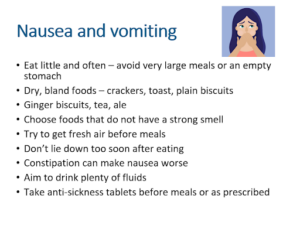
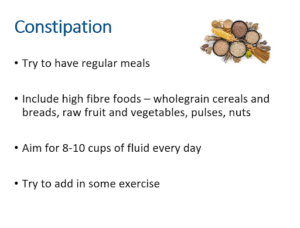
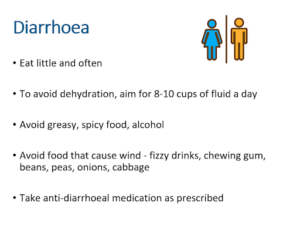
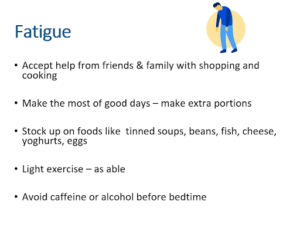
The dietary information in this PDF was developed by members of the HSE community dietitian national malnutrition working group with input from other groups in Ireland including community nurses, general practitioners and patients. The tips and advice are based on experience of what has worked for some people and may be helpful to you.
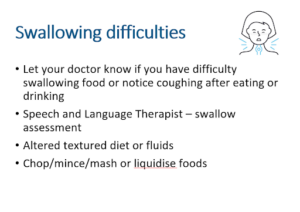
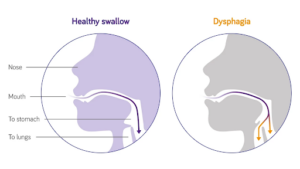
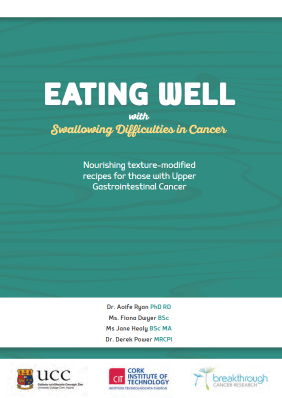
Many patients experience “dysphagia” – a change or difficulty in swallowing whilst on certain types of radiation treatment.
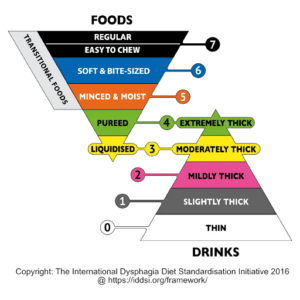
This means you may be advised to change the texture of your foods to make it easier and safer to swallow. This is called a “Modified diet”
Types of modified diets include:
Soft diets
Minced and moist diets
Puréed diets
Liquidised diets
You may also be advised to only drink liquids that are thickened. Thickened liquids are often easier to swallow as they “go down” the throat more slowly, allowing time for them to be swallowed into the “food pipe” (oesophagus) rather than spilling quickly into the windpipe.
You might see these diets being referred to as a numbered “level” – this is an international system of grading diets so that everyone knows the exact diet you have been advised to eat / drink.
Your Speech and Language Therapist (SLT) will advise you on the safest diet level.
Your Dietitian will then advise you on nourishing foods to eat within this type of diet.
There is lots of information and recipe books available to help you eat and drink well on your new diet level.
The Irish Head and Neck Society (ihns.ie) has wonderful videos from all of the team involved in caring for Head and Neck cancer Patients and their role. “This is Go” website also has a series of videos from all the team involved in gynaecological cancer care.
World Cancer Research Fund website and resources www.wcrf-uk.org
Referrals to the Dietitian in St. Luke’s are made by the medical and nursing team.
If you have concerns about your eating, drinking or are experiencing any weight changes whilst on treatment then please speak with a member of your medical team.
If you are finished your treatment, you can access community dietitians in your area via your GP
To provide the best experiences, we use technologies like cookies to store and/or access device information. Consenting to these technologies will allow us to process data such as browsing behaviour or unique IDs on this site. Not consenting or withdrawing consent, may adversely affect certain features and functions.
Functional
Always active
The technical storage or access is strictly necessary for the legitimate purpose of enabling the use of a specific service explicitly requested by the subscriber or user, or for the sole purpose of carrying out the transmission of a communication over an electronic communications network.
Preferences
The technical storage or access is necessary for the legitimate purpose of storing preferences that are not requested by the subscriber or user.
Statistics
The technical storage or access that is used exclusively for statistical purposes.The technical storage or access that is used exclusively for anonymous statistical purposes. Without a subpoena, voluntary compliance on the part of your Internet Service Provider, or additional records from a third party, information stored or retrieved for this purpose alone cannot usually be used to identify you.
Marketing
The technical storage or access is required to create user profiles to send advertising, or to track the user on a website or across several websites for similar marketing purposes.